Deposit your crypto, get paid to hold it. It sounds like the setup for every DeFi story that ended badly. But the mechanism behind it is one of the oldest strategies in traditional finance, and the founder who spent four years learning how to package it joined DimeTV to explain exactly where the money comes from and where the catch is. Meet Dan, founder of Rysk, one of the only onchain options protocols still standing from the first wave.
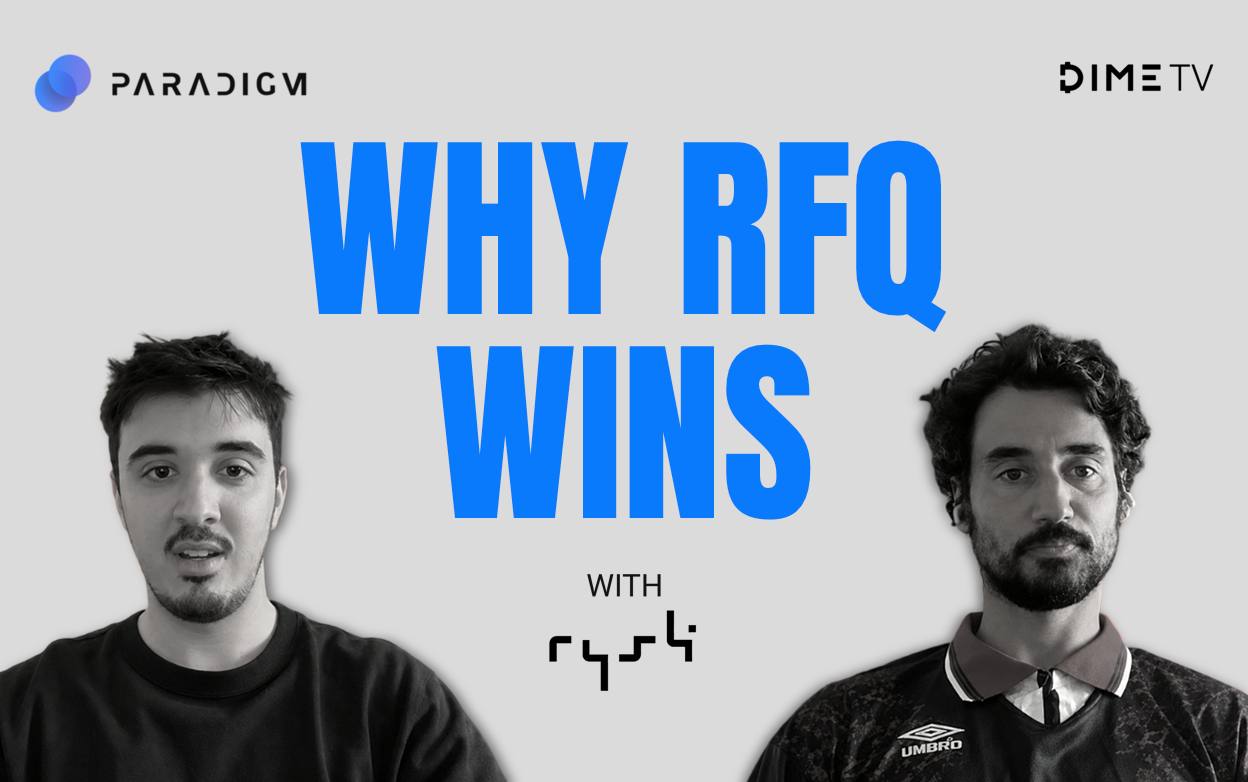
Watch the full episode. Rysk founder Dan on DimeTV: why the first wave of onchain options protocols died, how covered calls became DeFi's simplest yield, and why RFQ wins. Or read the highlights below.
This isn't a how-to on trading mechanics. If you want the foundations, our options series covers calls, puts, the Greeks, and how implied volatility is priced. This is a builder's postmortem and playbook: where covered call yield actually comes from, why almost every early onchain options protocol died, and why the liquidity answer turned out to be RFQ.
Featured guest
Dan, founder of Rysk, an onchain options protocol that turns covered calls and cash secured puts into a single yes or no question. Dan started in traditional finance at Merrill Lynch, found Ethereum through Berlin's crypto scene, and was pulled into DeFi for good after a painful position on Maker sent him looking for onchain insurance, which led him to the options protocol Opyn. Rysk's first product, an options AMM, failed. Its second act grew into one of the leading yield products on HyperEVM before expanding to Ethereum mainnet. He joined Paradex on DimeTV to explain what the failure taught him.
From the episode
Options are not the product. The first wave built for options traders. The users who actually showed up want yield on assets they already hold.
Two strategies, one question: are you happy to sell this asset at this higher price, or buy it at this lower one? Either way you are paid a premium.
The yield is real and so is the tradeoff. The risk is opportunity cost, not hidden leverage, and the premium comes from a counterparty, not emissions.
The users are wealth holders, not traders: treasuries, DAOs, funds, and long-term holders who want income on assets they intend to keep.
RFQ won the liquidity argument. AMMs bleed to informed flow and orderbooks demand dead capital across hundreds of strikes.
Why did the first wave of onchain options protocols fail?
Dan's answer starts with an admission: Rysk failed too. Its first version, an options AMM built on top of Opyn, launched into the same wall every peer hit. His diagnosis, looking back, is that the entire cohort made the same two mistakes. First, they tried to fight Deribit, replicating a centralized options exchange onchain and competing head-on with a venue that had already won that game. Second, and more fundamentally, they assumed the demand looked like the supply: that because options are traded by professionals, an onchain options product should be built for people who think in strikes, expiries, and implied volatility.
The users never came, because that user barely exists onchain. Crypto natives are perps people. Directional trading with leverage is one click and one number, while an options chain is two hundred squares of jargon. The insight that saved Rysk was to stop selling options and start selling the outcome: yield on the asset you already hold, with every Greek abstracted away.
"Our edge is not to build the best option exchange out there. Our edge is to package options in a way that we can target potentially any user."
— Dan, Founder, Rysk
What are covered calls and cash secured puts, in plain English?
Rysk runs on two strategies that have existed in traditional markets for decades. A covered call means you hold an asset and agree to sell it at a higher price by a set date. You are paid a premium immediately for that agreement. If the price never reaches your level, you keep the asset and the premium. If it does, you sell at a price you already said you were happy with, and still keep the premium.
A cash secured put is the mirror image: you set aside stablecoins and agree to buy an asset at a lower price you would be glad to accumulate at, collecting a premium for the commitment. If the asset never falls that far, you keep the premium and your stablecoins. If it does, you are buying at a level you chose, effectively getting paid to place a limit order you meant to place anyway.
The product design collapses each of these into one question on the screen: are you happy to sell this asset at this price, or buy it at that one? Yes or no. Everything else, pricing, volatility, settlement, is handled underneath. Dan argues that this simplicity is not a dumbing-down but a return to what an option actually is: a commitment about a price you would accept, compensated with income.
Want the mechanics under the hood? Our plain-English guides cover how options work and the covered call strategy in detail. You can trade BTC and ETH options with deep liquidity, around the clock, from a single self-custodial account on Paradex.
Where's the catch? The real risks of covered calls
Deposit your Bitcoin, get paid to hold it. Dan is direct about where the catch lives: the main risk is giving up upside. Sell a covered call struck well above spot and the asset triples, and you sold at the strike, not the top. Enter a cash secured put and the asset falls far below your level, and you are buying at the price you committed to, above the new market. Neither outcome involves hidden leverage or a blowup. Both are opportunity cost, crystallized. The strategies suit holders who genuinely mean the answer they give to that yes or no question, at levels they would be happy with anyway.
Where survival is concerned, the more important engineering is in what the protocol never does. The assets stay in audited contracts, the strategies are fully collateralized, and there is no rehypothecation stack behind the yield. The premium comes from a counterparty paying for the option, not from an emissions program or a token printer. That distinction, yield from a real buyer versus yield from thin air, is the line between this and the products that defined the last cycle's collapses.
Worth being clear about: selling options is not free money. A covered call caps your upside above the strike, and a cash secured put obliges you to buy into weakness. These are appropriate for holders who accept those outcomes at the levels they choose, and inappropriate for anyone who would regret them.
Who actually uses this
The user base surprised Dan. It is not traders, it is wealth. Long-term holders, treasuries, DAOs, and funds that hold assets like BTC, HYPE, or ETH as their balance sheet and want those assets working. Many had never used an options product before. For them the pitch is not "trade volatility," it is closer to a savings product with a stated tradeoff, which is exactly how the interface treats it.
Why does RFQ beat AMMs and orderbooks for options liquidity?
This is where Rysk's journey converges with Paradigm's founding thesis. Rysk's first version was an AMM, and the model has a structural problem with options: an automated curve has to price and hold inventory across every strike and expiry, and it bleeds to informed flow. Orderbooks have the opposite problem. A liquid book needs market makers to commit capital across hundreds of strikes and expiries simultaneously, most of which will never trade. As Dan describes it, committing liquidity all around those books is completely inefficient, dead capital as a structural requirement.
Request for quote inverts the model. Nothing is committed until someone actually wants to trade. The protocol asks a network of market makers to price the specific option, size, and expiry on demand, and the makers compete. It is the model Rysk settled on after trying the alternatives, and it is the model Paradigm has run for institutional block trades since the days when Deribit was the only venue that mattered.
"The RFQ I think is the best execution for option."
— Dan, Founder, Rysk
The Paradex angle: this is also where Paradex is heading. On-demand liquidity via RFQ is being built into Paradex options alongside the existing orderbook, so larger and more complex trades can be priced competitively the moment they are wanted rather than waiting in a book. The same execution model Dan converged on for packaged yield, and that Paradigm proved for institutional blocks, is coming to the venue itself.
What does Coinbase buying Deribit mean for onchain options?
Deribit spent a decade as the reference market for crypto options and, in Dan's telling, the operator that never made a mistake. Coinbase completed its acquisition of Deribit in August 2025, and Dan reads the moment two ways. In one direction, distribution: Coinbase can put Deribit's options in front of an enormous retail and institutional audience, and the incumbent gets stronger. In the other, he has watched enough acquisitions to know the integration path can slow the acquired product down.
Either way, his conclusion is not that onchain options need to take Deribit's share. The market that exists today is a fraction of what options should be in crypto, and the interesting move is growing the pie: reaching the holders, treasuries, and eventually traditional finance allocators who have never traded an option in their lives. Perps people will keep trading perps. The next options users come from somewhere else entirely, and they arrive through products that do not look like an options chain.
What is the RWA unlock for covered calls?
The forward-looking thread in the episode is what happens when the underlying stops being only crypto. Rysk is expanding to new assets, and Dan's eyes are on tokenized stocks, gold, and the broader RWA wave. The pitch writes itself: covered calls on tokenized equities, sold onchain, around the clock, from anywhere in the world. Selling a covered call on a stock position is a brokerage-account privilege that most of the world cannot access. A tokenized version is global by default.
His sharpest example is pre-IPO and hard-to-access names: imagine holding tokenized SpaceX and earning income on it, a trade that does not exist anywhere in traditional finance. That vision lines up with what other desks told us on DimeTV about tokenized assets and vault-traded funds: the infrastructure being built for crypto options generalizes to any tokenized underlying, and the demand side, wealth that wants income on what it holds, is the biggest untapped audience in the market.
What is the one thing to take away?
Onchain options did not fail because options are wrong for DeFi. They failed because protocols sold the instrument instead of the outcome. The survivor rebuilt around a yes or no question, found its users among holders rather than traders, and solved liquidity with RFQ instead of demanding dead capital in a book. For anyone watching where DeFi yield goes next, the takeaway from a founder who lost the first round is that the products that win will hide the machinery, state the tradeoff honestly, and let the person answer one question about a price they would accept. It is a bear market, Dan says, and that is the time to build.
Watch the full conversation. The complete episode with Dan, including the Maker wipeout that led him to Opyn, the Coinbase and Deribit verdict, and covered calls on tokenized SpaceX.
A covered call is a strategy where you hold an asset and agree to sell it at a set higher price by a set date, collecting a premium immediately for that agreement. Onchain protocols like Rysk package this into a single question, are you happy to sell at this price, and handle the option mechanics underneath. If the price never reaches your level, you keep the asset and the premium. If it does, you sell at a price you pre-approved and keep the premium as well.
A cash secured put is the mirror of a covered call: you set aside stablecoins and agree to buy an asset at a lower price you would be happy to accumulate at, and you are paid a premium for the commitment. If the asset stays above your level, you keep the premium and your stablecoins. If it falls below, you buy at your chosen level, effectively getting paid to place a limit order you meant to place anyway.
The main risk is opportunity cost rather than hidden leverage. If the asset rallies far past your strike, you sell at the strike and miss the additional upside. If you sold a cash secured put and the market falls hard, you buy at your committed level above the new market price. According to Rysk founder Dan, these strategies suit long-term holders who genuinely accept the prices they commit to, and the yield comes from a counterparty paying an option premium rather than from token emissions.
Rysk is an onchain options protocol that turns covered calls and cash secured puts into simple yield products. After its first version, an options AMM, failed alongside most of the first wave of onchain options protocols, Rysk rebuilt around the insight that options are not the product: users want yield on assets they already hold, with the mechanics abstracted away. It grew into one of the leading yield products on HyperEVM before expanding to Ethereum mainnet.
Options fragment liquidity across hundreds of strikes and expiries, so a liquid orderbook requires market makers to commit capital to quotes that mostly never trade, and an AMM must hold inventory across the whole surface. Request for quote, or RFQ, prices each trade on demand: makers compete to quote the exact option and size a taker wants, at the moment they want it. Rysk founder Dan calls RFQ the best execution for options, and it is the model Paradigm has used for institutional block trades since crypto options began.
About DimeTV
DimeTV is the media channel of Paradex, where the operators, traders, and builders shaping crypto's market structure share what they're seeing. This episode features Dan, founder of Rysk. Thanks to Dan for joining us. Follow DimeTV on X for new episodes.
Trade the strategies this episode is about. Open Paradex for BTC and ETH options, perps, and spot from one self-custodial account, built on the institutional liquidity of the team behind Paradigm.
This content is for informational purposes only and does not constitute financial, investment, or trading advice. The views expressed are those of the guest and do not necessarily reflect those of Paradex. Trading options, perpetuals, and other crypto derivatives involves substantial risk, including the loss of premiums paid and, on sold positions, losses beyond the premium received. Covered call and cash secured put strategies involve giving up potential upside and the obligation to buy or sell at committed prices. Leverage can amplify losses, including the rapid and total loss of capital during volatile events. Past performance is not indicative of future results. Do your own research before trading.
References to RFQ functionality on Paradex, tokenized assets, RWAs, and vaults describe an emerging and evolving area, including features and products that may be on a roadmap rather than currently available. Availability of products varies and some may not be live. Access to Paradex may be restricted in certain jurisdictions. Verify your local regulations before using the platform.
Quotes and paraphrased remarks are drawn from the DimeTV episode and have been lightly edited for clarity and length. References to third-party protocols and the Coinbase acquisition of Deribit reflect the guest's remarks and published reports, not Paradex data.
Deposit your crypto, get paid to hold it. It sounds like the setup for every DeFi story that ended badly. Rysk founder Dan joined DimeTV to explain where covered call income actually comes from, why almost every early onchain options protocol died, and why RFQ is the only execution model that works for options.


.svg)

