Spot holders eat every leg down. Directional traders are betting on a regime nobody can call in advance. Meanwhile, three vaults are about to start milking the markets via volatility premium harvesting, running hedged long/short books, and buying dips systematically. Cool enough? All these are also just a deposit away.
New to vault-traded funds? Start with The Rise of the VTF for what a VTF is and why it exists. This piece is the buyer's guide to the three DIME VTFs live today: how each one works, the regime each one loves and hates, and exactly what to check on-chain before you deposit.
See the numbers live. Every DIME VTF publishes AUM, APR, max drawdown, Sharpe, and depositor count on-chain. Open the vaults dashboard and read this guide with the real metrics next to it.
The short version
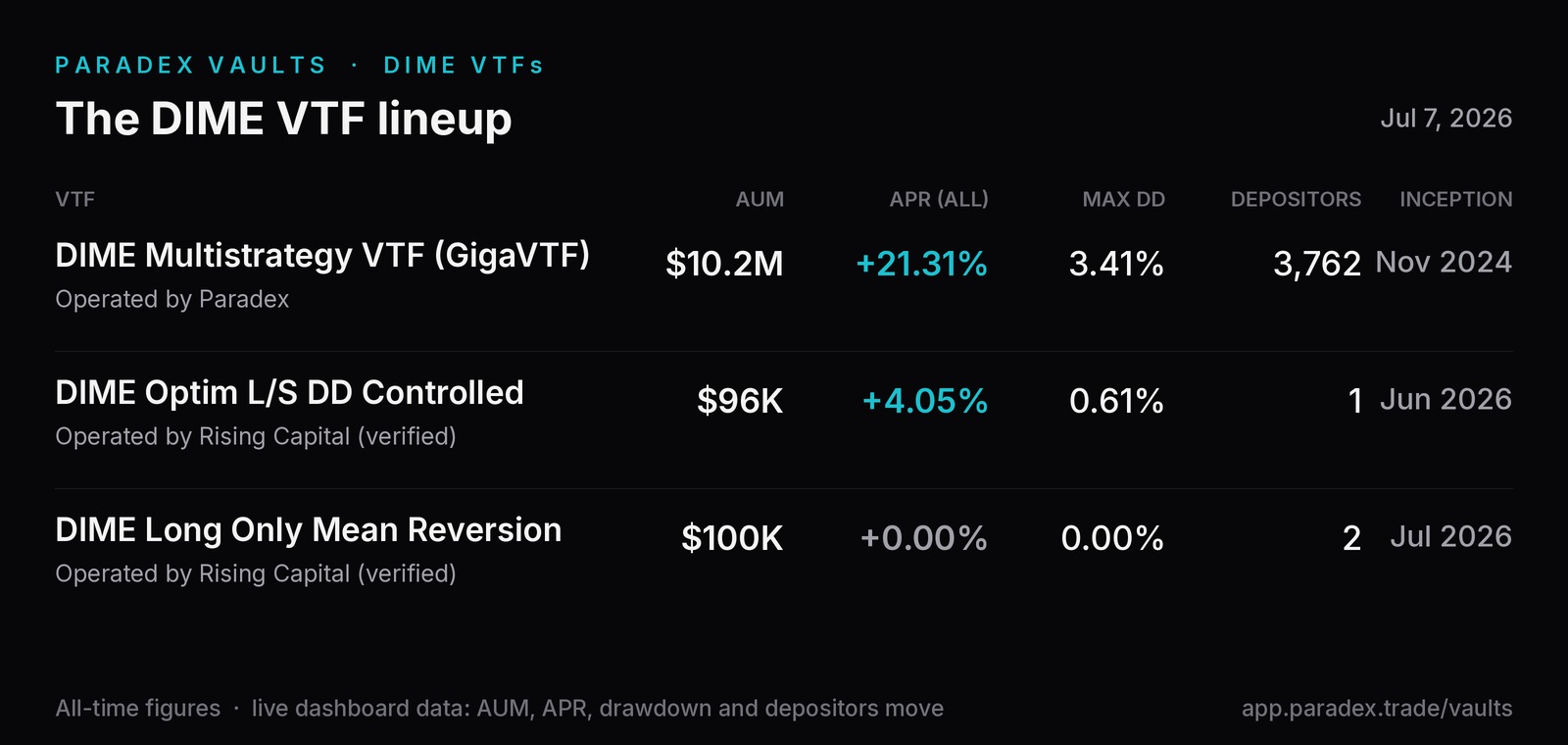
Three DIME VTFs are live: GigaVTF (multistrategy, run by Paradex), plus Optim L/S DD Controlled and Long-Only Mean Reversion, both run by Rising Capital, a verified third-party operator.
GigaVTF is the diversified anchor. Multiple uncorrelated sleeves, with the largest, systematic BTC options selling (managed by Monarq), capped at ~25% of the book so no single strategy makes or breaks the outcome.
Optim L/S pairs a momentum book with a contrarian book, roughly 50/50 in isolated risk budgets, designed to smooth the equity curve regardless of regime.
Long-Only Mean Reversion is the bull-market tool: systematic dip-buying, simplest to understand, most exposed to direction.
Before depositing: never read APR alone, pair it with Sharpe and max drawdown, know the 1-day lockup, and size for each vault's worst regime, not its best.
The DIME VTF lineup, live dashboard data as of July 7, 2026.
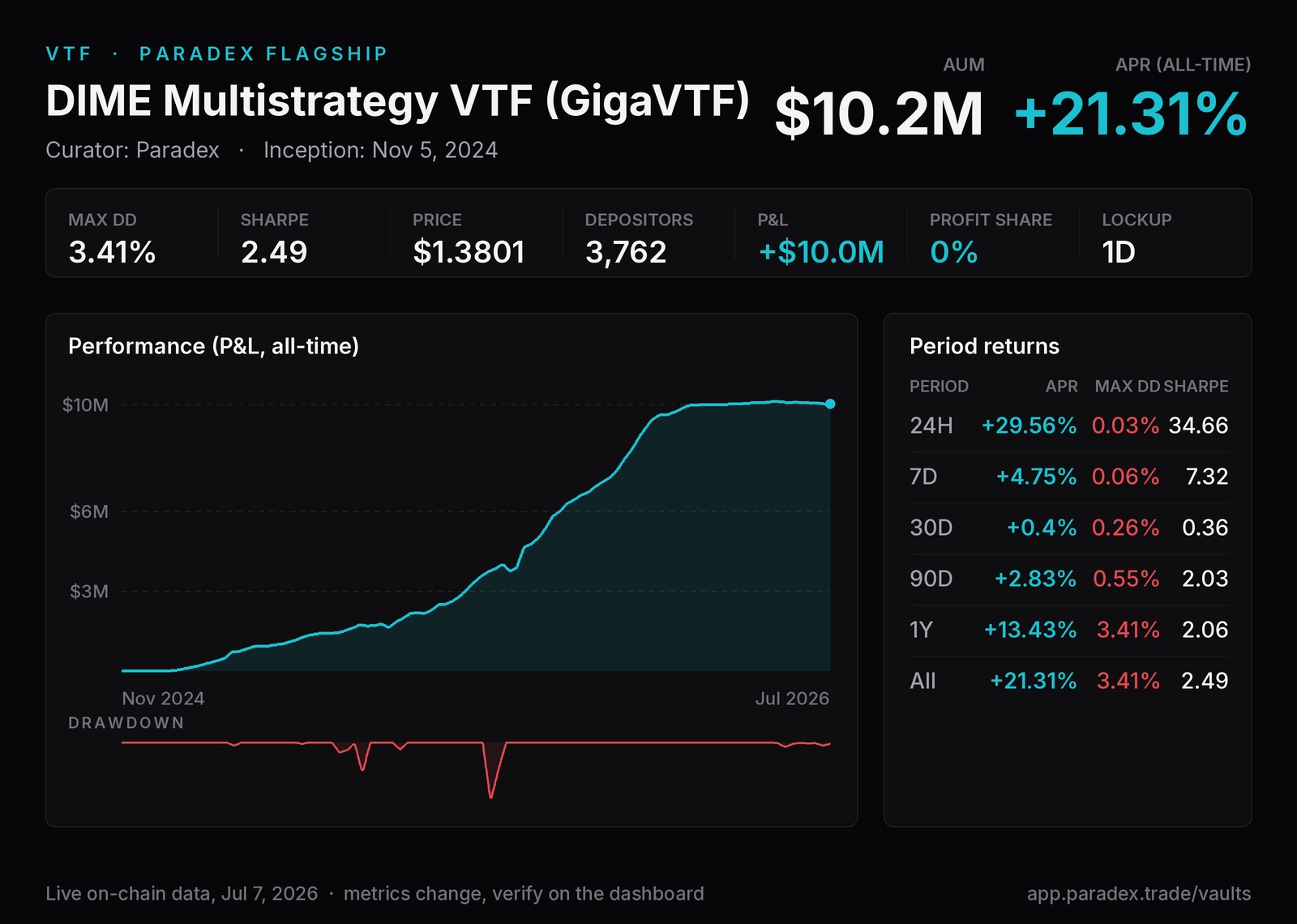
This VTF has multiple uncorrelated sleeves (BTC vol-premium harvesting, liquidation yields, directional perps, spot LP) so no single strategy makes or breaks the outcome. The largest sleeve is systematic BTC options selling + delta-hedging, managed by Monarq (@monarq_mgmt), which has a strong track record on its own, but is capped at ~25% of the book so the rest can absorb a hit.
GigaVTF, live dashboard data as of July 7, 2026: $10.2M AUM, 3,762 depositors, 1-day lockup. Metrics move, so check the dashboard for current figures.The sleeves in practice, July 7, 2026: BTC volatility premium is the largest allocation at ~24% of the book, inside the ~25% cap.
Best for: idle USDC, or a low-variance anchor under more concentrated bets.
Trade-off: smoother ride means lagging pure directional plays in a strong uptrend.
Worst case: a deep, correlated crash where multiple sleeves draw down together.
2. DIME Optim L/S DD Controlled VTF, operated by Rising Capital
Two complementary strategies in a single vault, regardless of market regime.
Note: While this carries the DIME VTF label, it is run by Rising Capital (@Rising_Cap), a third-party desk that has passed Paradex's operator verification, not run by the Paradex team directly.
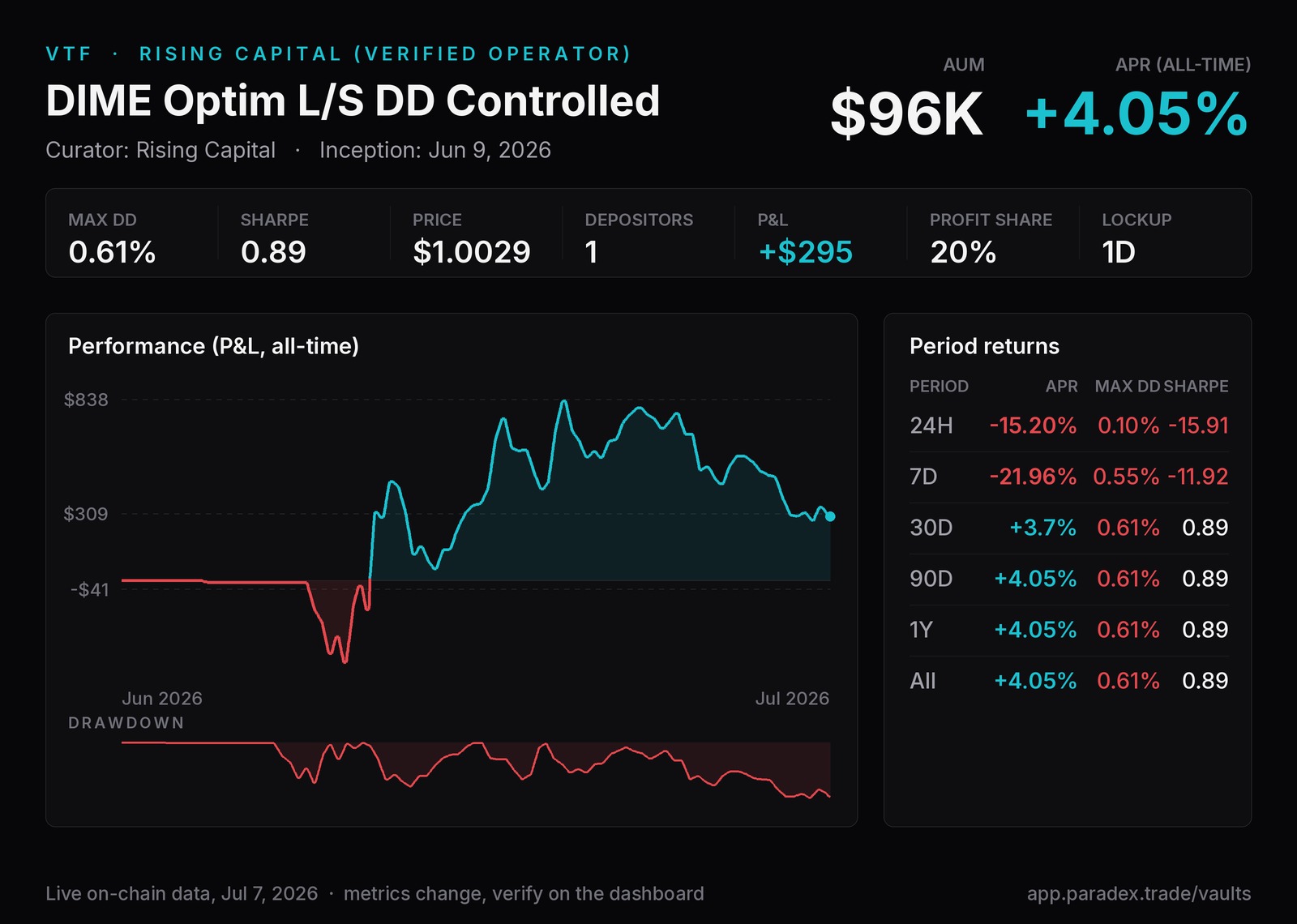
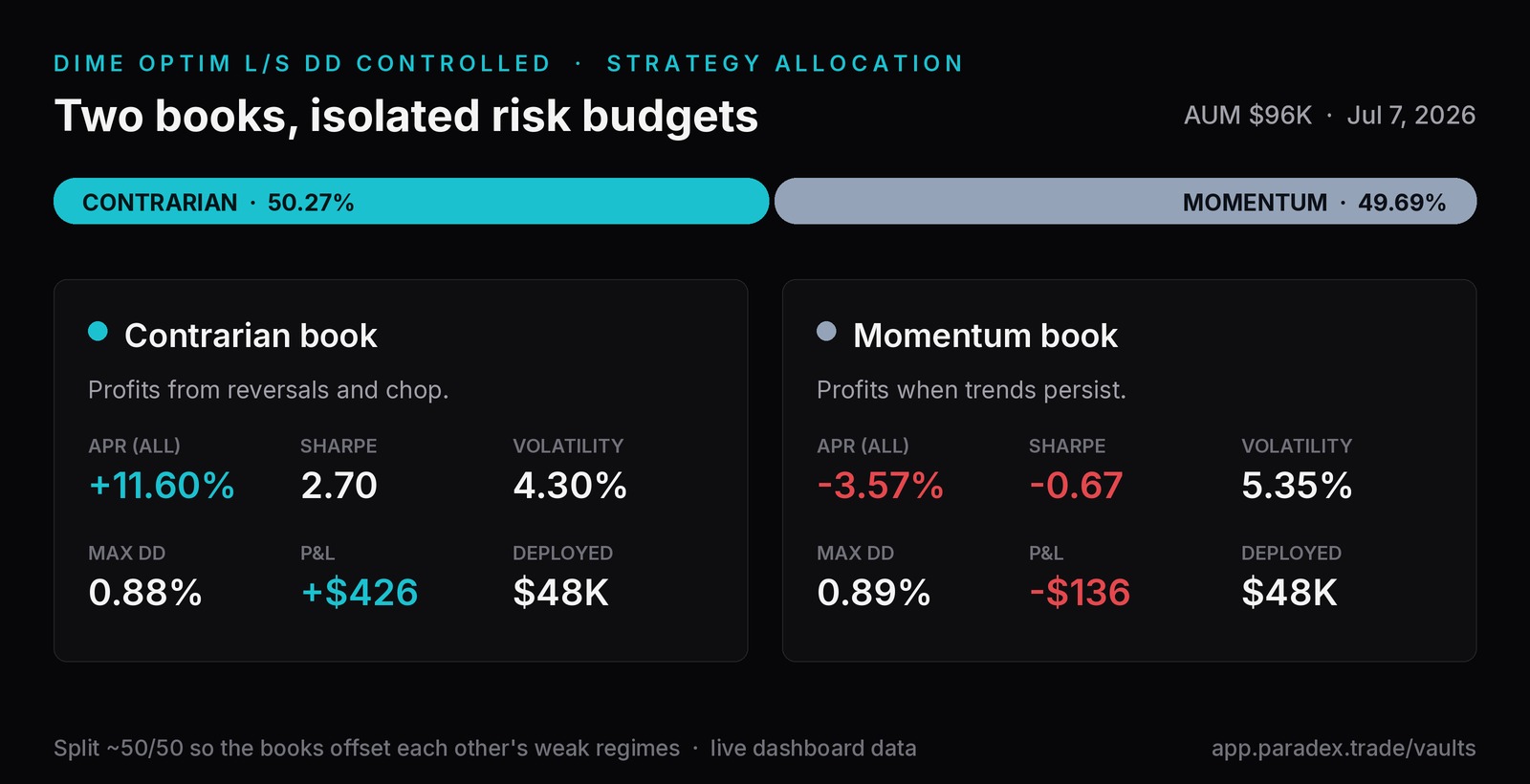
Two complementary sub-strategies run in isolated books with separate risk budgets, split roughly 50/50: a momentum book that profits when trends persist, and a contrarian book that profits from reversals and chop. Because the two are built to offset each other's weak regimes, the combined equity curve is designed to smooth out regardless of what the market does.
Optim L/S, live dashboard data as of July 7, 2026. An early-stage vault (inception June 9, 2026); metrics move, so check the dashboard for current figures.The 50/50 split live, July 7, 2026: contrarian and momentum books in isolated risk budgets. One up, one down, by design.
Best for: systematic long/short exposure without running the book yourself, or as a satellite that behaves nothing like spot holdings.
Trade-off: the 50/50 split dilutes upside if one sleeve massively outperforms alone.
Worst case: a sharp whipsaw that hits both sleeves at once, plus operator risk on Rising Capital's signals.
3. DIME Long-Only Mean Reversion VTF, operated by Rising Capital
The bull-market tool. Simplest to understand, most exposed to direction.
Note: Also run by Rising Capital under the same verified-operator framework.
This VTF is long-only, always systematic dip-buying that buys weakness and trims strength within an uptrend or range, rather than chasing breakouts.
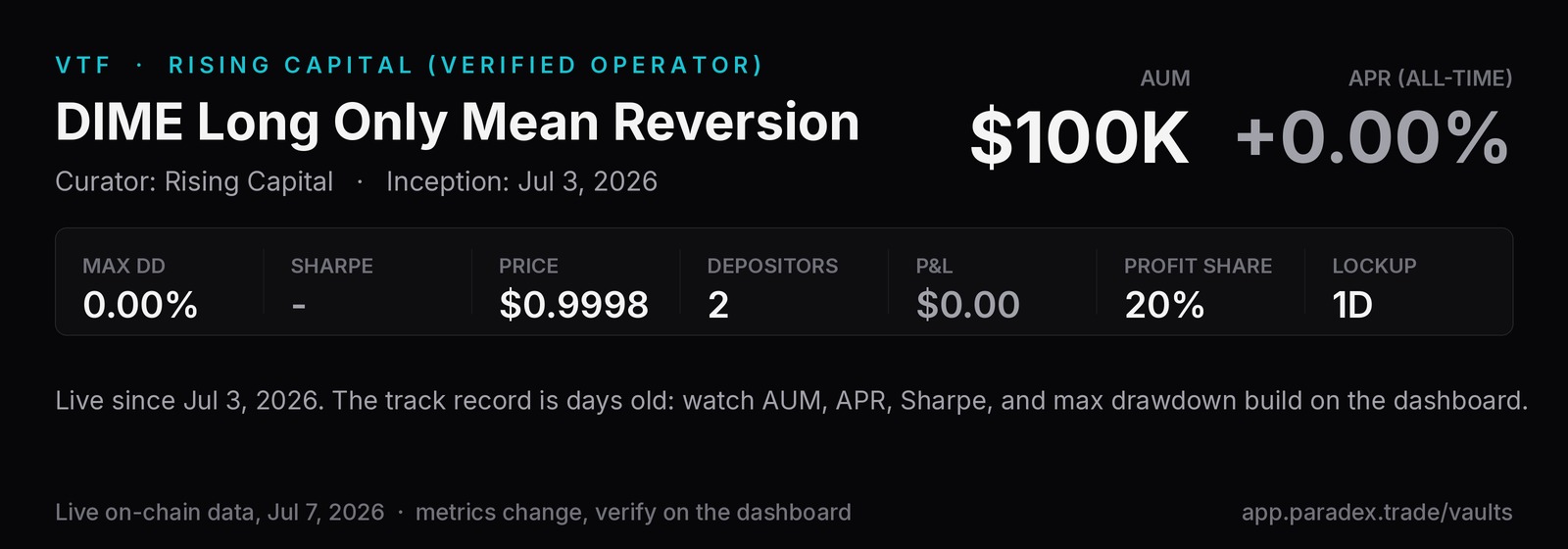
Long Only Mean Reversion, live dashboard data as of July 7, 2026. Live since July 3, so the track record is days old; watch it build on the dashboard.
Best for: traders already bullish and want a disciplined, rules-based way to express it.
Trade-off: structurally net long, with no short book to hedge a broad selloff.
Worst case: a sustained downtrend, where "buying the dip" becomes catching a falling knife.
Compare them live before you allocate. Every DIME VTF publishes AUM, APR, max drawdown, Sharpe, and depositor count on-chain, so you can read the numbers instead of a pitch deck, then size for the worst regime, not the best one.
Take note, three risks apply across the board for the VTFs and shouldn't be ignored just because they're shared:
Operator risk. Every vault, including the Paradex-run flagship, depends on the operator's models, execution, and discipline. Verified status reduces this risk but doesn't remove it.
Fees. Each VTF charges a specific performance fee unless otherwise stated. You can check this per vault on the dashboard, which is deducted before the returns you see.
Protocol risk. These are on-chain products. So smart contract risk, bridge risk and USDC exposure apply to all three equally.
Getting Started
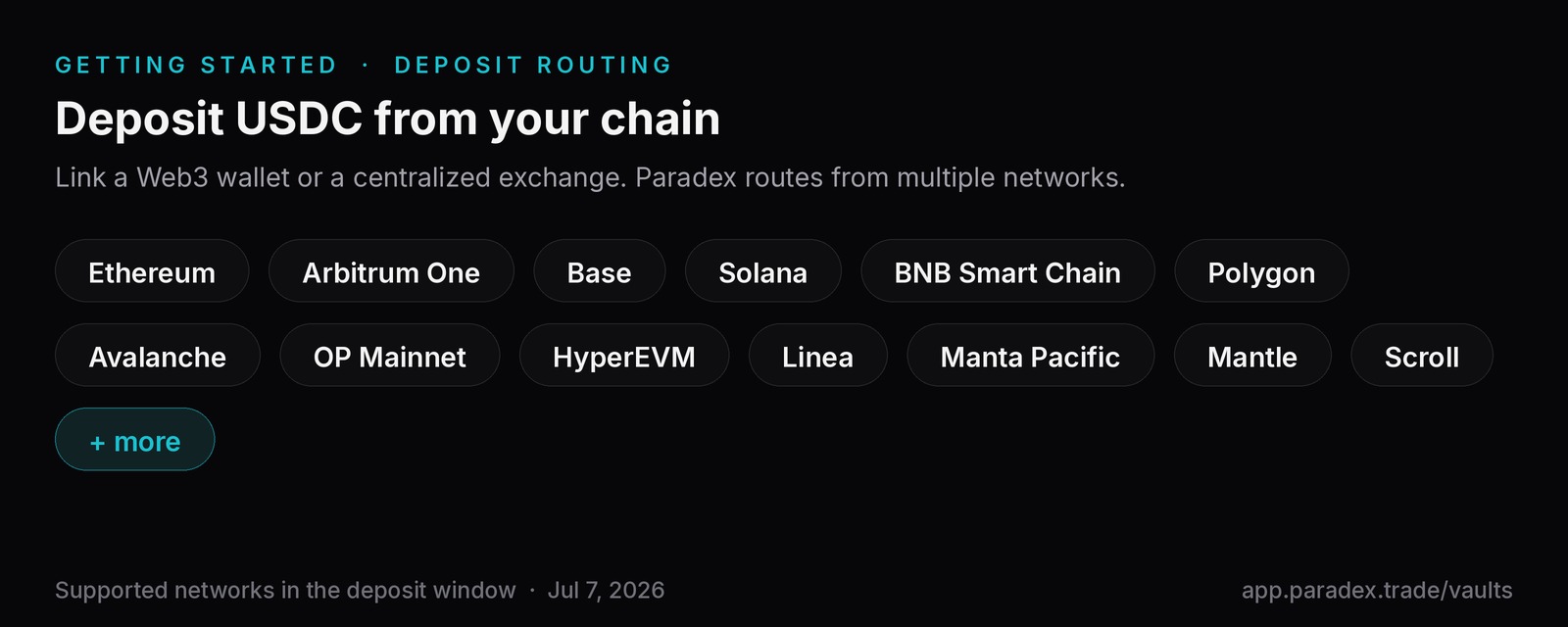
Routing from multiple networks: Ethereum, Arbitrum One, Base, BNB Smart Chain, Solana, Polygon, and more.
Connect and fund: Link a Web3 wallet or centralized exchange, then deposit USDC. Paradex supports routing from multiple networks.
Check the on-chain metrics before allocating: Every VTF publishes AUM (is it large and widely held, or thin and concentrated?), APR, max drawdown, Sharpe, and depositor count.
Never read APR alone. Pair it with Sharpe and drawdown. A 12% APR at 0.7% drawdown and a 12% APR at 40% drawdown are not the same product, even with the identical headline number.
Know the lockup. Each deposit currently carries a 1-day lockup, so size positions with capital you're comfortable holding through short-term shocks.
Size for the worst case, not the best one. Every vault above has a regime it handles the worst. These only compound if you can sit through the bad stretch instead of withdrawing near the bottom.
What's next
This was the 30,000-foot view. Deeper breakdowns on each VTF where the mechanics, risk profile, and how to actually size a position are coming soon. For now, the vaults are live, the metrics are verifiable on-chain, and the dashboard is one USDC deposit away.
Frequently asked questions
A DIME VTF is a vault-traded fund on Paradex: an on-chain vault that runs a defined trading strategy on deposited USDC, with performance verifiable on-chain. Every VTF publishes its AUM, APR, max drawdown, Sharpe ratio, and depositor count on the Paradex dashboard, and each deposit currently carries a 1-day lockup. Three DIME VTFs are live: the Paradex-run multistrategy GigaVTF, and two vaults, Optim L/S DD Controlled and Long-Only Mean Reversion, run by Rising Capital, a third-party desk verified under Paradex's operator framework.
GigaVTF is the diversified core: multiple uncorrelated sleeves (BTC vol-premium harvesting, liquidation yields, directional perps, spot LP) with low-to-moderate directional risk, built to work in any regime. Optim L/S DD Controlled runs a momentum book and a contrarian book roughly 50/50 in isolated risk budgets, aiming for a smoother equity curve with capped downside, strongest in trending, volatile markets. Long-Only Mean Reversion is the simplest and most directional: systematic dip-buying with no short book, suited to bullish traders and weakest in a sustained downtrend.
The flagship DIME Multistrategy VTF (GigaVTF) is operated by Paradex itself. Its largest sleeve, systematic BTC options selling and delta-hedging, is managed by Monarq. The Optim L/S DD Controlled and Long-Only Mean Reversion VTFs carry the DIME label but are run by Rising Capital, a third-party trading desk that has passed Paradex's operator verification. Verification reduces operator risk but does not remove it: every vault, including the Paradex-run flagship, still depends on its operator's models, execution, and discipline.
Three risks apply to all DIME VTFs: operator risk (every vault depends on its operator's models and execution), fees (each VTF charges a performance fee, shown per vault on the dashboard and deducted before the returns you see), and protocol risk (smart contract, bridge, and USDC exposure, since these are on-chain products). Each vault also has a worst regime, a deep correlated crash for GigaVTF, sharp whipsaw reversals for the long/short vault, and a sustained downtrend for the mean reversion vault, so size positions for the worst case, not the best one.
Link a Web3 wallet or a centralized exchange, deposit USDC (Paradex supports routing from multiple networks), and pick a vault on the dashboard. Before allocating, check the on-chain metrics: AUM, APR, max drawdown, Sharpe, and depositor count, and never read APR alone, since a 12% APR at 0.7% drawdown and a 12% APR at 40% drawdown are not the same product. Note the 1-day lockup on each deposit and size positions with capital you are comfortable holding through short-term shocks.
This article is for educational purposes only and is not financial advice. All strategies carry risk, including the risk of loss. Verify all vault metrics and strategy descriptions on the live Paradex dashboard before depositing.
DIME VTFs involve operator risk, smart contract risk, bridge risk, and stablecoin (USDC) exposure. The Optim L/S DD Controlled and Long-Only Mean Reversion VTFs are operated by Rising Capital, a third-party desk verified under Paradex's operator framework; verification reduces but does not eliminate operator risk, and third-party strategies are not run by Paradex. Deposits currently carry a 1-day lockup. Performance fees apply per vault as shown on the dashboard. Access to Paradex may be restricted in certain jurisdictions; verify your local regulations before using the platform.




.svg)

