

24/7 Options and Futures Trading with Privacy.

.svg)


TLDR: Fee structure - not your win rate - is what's quietly draining your scalping P&L.
On Binance, a 0.1% scalp at 50x leverage nets exactly $0 after fees.
On Paradex, retail now pays 0% maker and 0% taker, so the same trade returns the full 5.00%.
We ran the math on 10 BTC and 8 Gold scalps at representative prices. The difference compounds fast.
If you scalp futures at 20x or above, the numbers below are worth five minutes.
Your strategy may not be the problem - the fee structure is.
Prefer directional exposure without liquidation risk? Paradex also offers perpetual options - leveraged positions that don't get wiped by a wick.
Most scalpers already know fees matter. But until you run the numbers side by side, it's easy to underestimate just how much fee structure - not entry accuracy - defines whether a strategy is profitable at high leverage.
Drag the sliders to match how you actually trade, and watch the monthly drag move.
How much are fees costing you?
Adjust your trade size and volume to see your real monthly saving.
Monthly saving vs Binance
$3,000/mo
This piece compares Paradex's fee structure against both Binance Regular and Binance VIP 3 (with BNB discount), across realistic BTC and Gold (PAXG) trade simulations at representative prices.
Here's the fee structure across the three tiers we're comparing.
| Metric | Paradex (Retail) | Binance Regular | Binance VIP 3 (+BNB fees) |
|---|---|---|---|
| Maker fee | 0% | 0.02% | 0.0108% |
| Taker fee | 0% | 0.05% | 0.0288% |
| Round-trip taker | 0% | 0.10% | 0.0576% |
| Requirements | None | None | ~$50M/30d + 100 BNB |
VIP 3 base: 0.012% maker / 0.032% taker, with 10% BNB payment discount applied.
Retail pays nothing, maker or taker. Professional and API traders pay a tiered rate and can reduce it by staking DIME or paying fees in DIME. See the full fee schedule →
Fees aren't the only cost eating into your scalps - funding rates matter too at high leverage. How Paradex handles funding differently from other perp DEXs →
10 simulated trades modeled on tight BTC moves at representative prices. Setup: $100 margin, 50× leverage = $5,000 notional per trade. Taker (market) orders on both open and close.
| # | Entry | Exit | Move | Gross P&L | Binance Reg. Net | Binance VIP 3 Net | Paradex Net |
|---|---|---|---|---|---|---|---|
| 1 | $64,000 | $64,045 | +0.07% | $3.50 | -$1.50 | $0.62 | $3.50 |
| 2 | $64,045 | $64,109 | +0.10% | $5.00 | $0.00 | $2.12 | $5.00 |
| 3 | $64,109 | $64,173 | +0.10% | $5.00 | $0.00 | $2.12 | $5.00 |
| 4 | $64,173 | $64,301 | +0.20% | $10.00 | $5.00 | $7.12 | $10.00 |
| 5 | $64,301 | $64,397 | +0.15% | $7.50 | $2.50 | $4.62 | $7.50 |
| 6 | $64,397 | $64,461 | +0.10% | $5.00 | $0.00 | $2.12 | $5.00 |
| 7 | $64,461 | $64,493 | +0.05% | $2.50 | -$2.50 | -$0.38 | $2.50 |
| 8 | $64,493 | $64,557 | +0.10% | $5.00 | $0.00 | $2.12 | $5.00 |
| 9 | $64,557 | $64,622 | +0.10% | $5.00 | $0.00 | $2.12 | $5.00 |
| 10 | $64,622 | $64,751 | +0.20% | $10.00 | $5.00 | $7.12 | $10.00 |
| Total | $58.50 | $8.50 | $29.70 | $58.50 | |||
After the same 10 trades a Paradex scalper is sitting on $58.50 in net profit, the entire gross, while a Binance Regular trader has $8.50 - and that's if they even kept trading through the four consecutive zero/negative-net trades in the middle.
Scam wicks are another silent cost for leveraged scalpers - an unfair wick can wipe a position even if the trade direction is right. How Paradex protects against unfair liquidations →
| Metric | Binance Regular | Binance VIP 3+BNB | Paradex |
|---|---|---|---|
| Fees paid | $50.00 | $28.80 | $0.00 |
| Net P&L | $8.50 | $29.70 | $58.50 |
| ROI on $100 margin | 8.5% | 29.7% | 58.5% |
On Paradex, a winning read is a winning trade. The psychological difference of maintaining a clean win streak - versus seeing correct calls show as losses - is real for anyone who has scalped through a session.
Gold tends to move in tighter percentage terms than BTC within a session, which makes the fee impact even more pronounced. Same parameters: $100 margin, 50× leverage, taker execution - but with two losing trades included.
| # | Entry | Exit | Move | Gross P&L | Binance Regular net | Binance VIP 3+BNB net | Paradex net |
|---|---|---|---|---|---|---|---|
| 1 | $4,250 | $4,254 | +0.10% | $5.00 | $0.00 | $2.12 | $5.00 |
| 2 | $4,254 | $4,260 | +0.15% | $7.50 | $2.50 | $4.62 | $7.50 |
| 3 | $4,260 | $4,257 | -0.07% | -$3.50 | -$8.50 | -$6.38 | -$3.50 |
| 4 | $4,257 | $4,266 | +0.20% | $10.00 | $5.00 | $7.12 | $10.00 |
| 5 | $4,266 | $4,262 | -0.10% | -$5.00 | -$10.00 | -$7.88 | -$5.00 |
| 6 | $4,262 | $4,266 | +0.10% | $5.00 | $0.00 | $2.12 | $5.00 |
| 7 | $4,266 | $4,270 | +0.09% | $4.50 | -$0.50 | $1.62 | $4.50 |
| 8 | $4,270 | $4,279 | +0.20% | $10.00 | $5.00 | $7.12 | $10.00 |
| Total | $33.50 | -$6.50 | $10.46 | $33.50 | |||
Six wins, two losses, a 75% hit rate that most scalpers would take. But on Binance Regular, you're net negative despite being right on 6 out of 8 trades. Fees don't just shrink your winners - they amplify your losers.
The strategy isn't wrong. The fee structure just doesn't leave room for tight moves to be profitable. At 0%, every one of those eight trades banks its full gross.
Per-trade differences compound fast. Here's what the fee drag looks like for a scalper doing 20 taker round-trips per day on $100 margin at 50x:
| Metric | Binance Regular | Binance VIP 3 + BNB | Paradex |
|---|---|---|---|
| Daily fees | $100.00 | $57.60 | $0.00 |
| Monthly fees (30 days) | $3,000 | $1,728 | $0 |
| Annual saving vs. Binance Reg | - | $15,264 | $36,000 |
On Paradex, retail pays $0 on both sides now, maker or taker, limit or market. Every dollar of gross profit goes straight to your account. That's the Zero Fee Perps model, now extended to taker orders too, so retail pays nothing either way.
It's not a promo with a countdown. Retail flow is non-toxic, so Paradex prices it at zero by design and earns from professional and API flow instead. See the full fee schedule →
At the default settings above, Paradex saves you $3,000 every month vs Binance Regular. Same trades. Same strategy. Just better math.
See it for yourself →Low fees are the foundation. On top of that, Paradex has built features around the problems that cost scalpers money on other platforms:
Spot the entry. Set the order. All in one view. Trading at the speed of thought is what scalpers do.
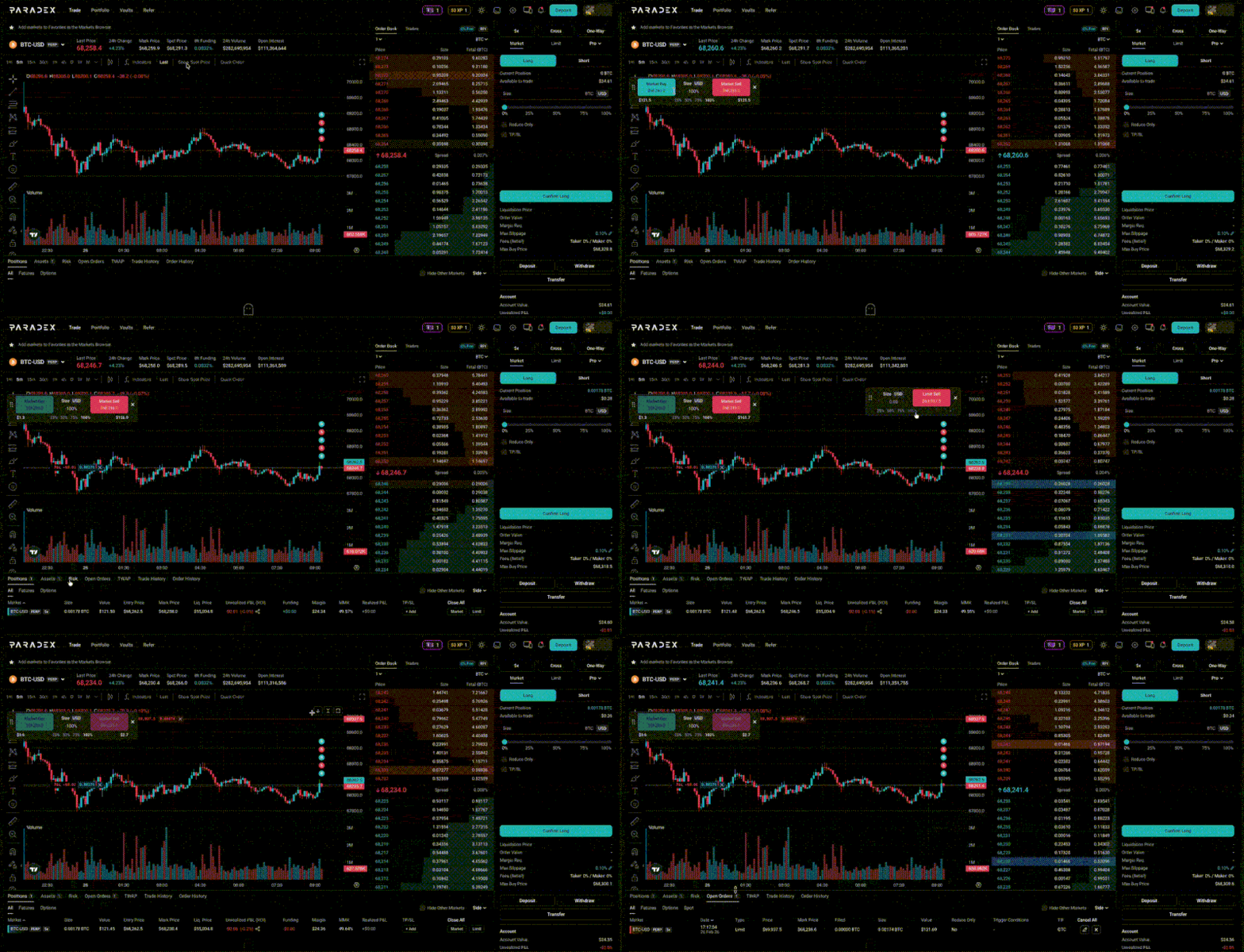
Spot the entry. Set the order. All in one view.
High-frequency scalpers also benefit from on-chain privacy - large or repeated positions visible on-chain can be front-run. Why broadcasting your moves costs you money →
Perp fees are just one side of the equation. If you want leveraged exposure without liquidation risk from price moves, here is a plain-English introduction to crypto options on Paradex.
The core argument is simple: Paradex's fee structure means strategies that don't work on Binance become consistently profitable. Your win rate goes up without changing your entries.
$36,000 saved per year, per setup. No VIP tiers. No minimum volume. No BNB to hold. Just a fee structure that was built to not punish high-frequency traders.
Want the bigger picture on where perp DEXs are heading? The $8 trillion institutional endgame for perp DEXs →
No. As of June 2026, retail traders on Paradex pay 0% maker and 0% taker fees on all products: perpetuals, spot, and options. For an active scalper, every dollar of gross profit is kept, with nothing taken on the way in or out. Professional and API traders pay a tiered rate instead.
It adds up fast. A scalper running 20 round-trips a day on a $5,000 position pays roughly $3,000 a month on Binance Regular and about $1,728 on Binance VIP 3. On Paradex retail the same activity costs $0, a saving of around $36,000 a year versus Binance Regular.
No. It is the pricing model, not a discount with a countdown. Paradex prices retail flow at zero because that flow is non-toxic and valuable to market makers, and it earns from professional and API flow instead. There is no end date.
For retail there is no difference: both maker and taker are 0% across perps, spot, and options. For professional and API traders, maker fees are 0% and taker fees follow a volume-based tier, roughly 0.045% down to 0.035%, which can be reduced further by staking DIME or paying fees in DIME.
No. Because retail flow is non-toxic, market makers can quote tighter spreads with more size against it, so pricing stays competitive. Your real cost is fees plus spread plus funding; with retail fees at zero, the main remaining costs are spread and funding, both set by the market.
No minimums. No VIP tiers. Every winning trade stays a winning trade.
Open my account →Paradex is a decentralised perpetuals exchange with full on-chain privacy built by the Paradigm team. Learn more about who we are
Paradex is a decentralised perpetuals exchange with full on-chain privacy built by the team behind Paradigm.
Trading perpetual futures and other derivatives involves substantial risk. Leveraged positions can result in losses exceeding your initial margin. This content is for informational purposes and does not constitute financial advice. Do your own research.